 In 2013, I vow to post here more than once a year. Even once a month would significantly improve my recent record! I have a plan. We'll see how it goes.
For now, I have a new book to share. Planet Ark: Preserving Earth's Biodiversity is (hopefully) in (or shipping to) a bookstore near you.
There are already a few reviews in the ether. One from Kirkus Review, and a nice surprise - a starred review from Publishers Weekly.
It's been a few years since I've written a book for children. This one was a nice departure from my usual "straight up" science books as, being more of a non-fiction picture book, it gave me some more scope to be a bit lyrical. And it was nice to be in a partnership with a very skilled artist, Margot Thompson who has illustrated other books for Kids Can Press as well (while also managing to be an exhibit designer at the Royal Ontario Museum!).
More soon. Really.
In 2013, I vow to post here more than once a year. Even once a month would significantly improve my recent record! I have a plan. We'll see how it goes.
For now, I have a new book to share. Planet Ark: Preserving Earth's Biodiversity is (hopefully) in (or shipping to) a bookstore near you.
There are already a few reviews in the ether. One from Kirkus Review, and a nice surprise - a starred review from Publishers Weekly.
It's been a few years since I've written a book for children. This one was a nice departure from my usual "straight up" science books as, being more of a non-fiction picture book, it gave me some more scope to be a bit lyrical. And it was nice to be in a partnership with a very skilled artist, Margot Thompson who has illustrated other books for Kids Can Press as well (while also managing to be an exhibit designer at the Royal Ontario Museum!).
More soon. Really.
Showing posts with label non-fiction picture books. Show all posts
Showing posts with label non-fiction picture books. Show all posts
Saturday, April 06, 2013
Planet Ark Sets Sail
In 2013, I vow to post here more than once a year. Even once a month would significantly improve my recent record! I have a plan. We'll see how it goes.
For now, I have a new book to share. Planet Ark: Preserving Earth's Biodiversity is (hopefully) in (or shipping to) a bookstore near you.
There are already a few reviews in the ether. One from Kirkus Review, and a nice surprise - a starred review from Publishers Weekly.
It's been a few years since I've written a book for children. This one was a nice departure from my usual "straight up" science books as, being more of a non-fiction picture book, it gave me some more scope to be a bit lyrical. And it was nice to be in a partnership with a very skilled artist, Margot Thompson who has illustrated other books for Kids Can Press as well (while also managing to be an exhibit designer at the Royal Ontario Museum!).
More soon. Really.

Saturday, March 12, 2011
Canadian Books For International Women's Day
A belated post, but every day can be International Women's Day can't it? I asked some of my writing colleagues for their recommendations of books written by Canadian authors that feature strong female characters. Here are some of their responses with links.
Sydell Waxman has two titles for young reachers: Changing the Pattern: The Story of Emily Stowe
(Illustrated by Linda Potts).
When Emily Stowe was born in 1831, every girl's future was limited to housework and child care. Women were not allowed into universities. They were not allowed to vote. Yet, Emily Stowe became Canada's first woman school principal, the first woman to practise medicine in Canada and a fighter for women's rights. How did she do it? Recommended for grades 4-8.
and
Believing in Books: The Story of Lillian Helena Smith
Every time you walk into the children's section of your local library, you should be thanking Lillian H. Smith. When Lillian was young, libraries had reading rooms with signs that often said, "No children or dogs allowed." Yet, Lillian H. Smith became Canada's first children's librarian and set up one the best collections of fine children's books in our country. How did she convince people that children's books matter? How did she choose "good" children's books? Recommended for grades 4-8.
The Trouble with Dilly by Rachna Gilmore (Grades 3 and up).
Dilly is strong, feisty, scatty and wildly imaginative, and plays hockey in a mixed team. Here's a review from CM.
And here's a picture book from Rachna: Catching Time.
When Sara's family can't find time to take her to the park, she sets about trying to catch some time for them all.
Marthe Jocelyn's Scribbling Women: True Tales from Astonishing Lives. Here is a blurb from Gillian O'Reilly, a fan of this title: "It's about women who were writers but not the ones we usually think about. It includes a woman transported to Australia in the early 1800s, a wonderful African explorer (you should see the photo of her in her bonnet), the 10th century Japanese courtier Sei Shonagon, a crusading American journalist who disguised herself as a mentally ill patient to expose New York treatments in the early 1900s, and Ada Blackjack, an Inuit woman who was part of a polar expedition. And more... It's a great read"
From Margriet Ruurs there is a novel, Me & Martha Black. Protagonist Melanie wanders through the history of the Yukon, with Martha Black - who became the second woman in Parliament - as her guide.
lian goodall's Singing Towards the Future: The Story of Portia White, tells the story of this Nova Scotian contralto.
(ages 11 and up)
From editors, Jocelyn Shipley and Deb Loughead, Cleavage: Breakaway Fiction for Real Girls, a book of stories about teens and their moms and body images issues. This title made the ALA's 2010 Amelia Bloomer Project List.
For an emotionally strong character that must overcome incredible personal challenges, look to Cheryl Rainfield's Scars. "Kendra must face her past and stop hurting herself--before it's too late...." Scars was a finalist for the Governor General Literary Award.
And here are two titles from Frieda Wishinsky:
Make It Fair!, which is #15 in the Canadian Flyer Adventure Series. This title features a great Canadian female: Nellie McClung. "Can Emily and Matt help suffragette Nellie McClung in the fight for women's rights? In Make It Fair! Emily and Matt land in Premier Rodmond Roblin's office in Winnipeg in 1914 and discover Nellie McClung confronting the Manitoban politician on the issue of women's rights.
Manya's Dream: A Story Of Marie Curie introduces the life of this two-time Nobel Prize winner (for physics and chemistry, no less) to younger readers. Here's a review.
And, finally*, I'd like to mention Elizabeth MacLeod, who has written a number of biographies about inspiring women, including Helen Keller, Eleanor Roosevelt, and Marie Curie. And, of course, she also wrote, The Kids Book of Great Canadian Women!
*Finally for now. Please send along any other titles you'd like to suggest.
Sydell Waxman has two titles for young reachers: Changing the Pattern: The Story of Emily Stowe
(Illustrated by Linda Potts).
When Emily Stowe was born in 1831, every girl's future was limited to housework and child care. Women were not allowed into universities. They were not allowed to vote. Yet, Emily Stowe became Canada's first woman school principal, the first woman to practise medicine in Canada and a fighter for women's rights. How did she do it? Recommended for grades 4-8.
and
Believing in Books: The Story of Lillian Helena Smith
Every time you walk into the children's section of your local library, you should be thanking Lillian H. Smith. When Lillian was young, libraries had reading rooms with signs that often said, "No children or dogs allowed." Yet, Lillian H. Smith became Canada's first children's librarian and set up one the best collections of fine children's books in our country. How did she convince people that children's books matter? How did she choose "good" children's books? Recommended for grades 4-8.
The Trouble with Dilly by Rachna Gilmore (Grades 3 and up).
Dilly is strong, feisty, scatty and wildly imaginative, and plays hockey in a mixed team. Here's a review from CM.
And here's a picture book from Rachna: Catching Time.
When Sara's family can't find time to take her to the park, she sets about trying to catch some time for them all.
Marthe Jocelyn's Scribbling Women: True Tales from Astonishing Lives. Here is a blurb from Gillian O'Reilly, a fan of this title: "It's about women who were writers but not the ones we usually think about. It includes a woman transported to Australia in the early 1800s, a wonderful African explorer (you should see the photo of her in her bonnet), the 10th century Japanese courtier Sei Shonagon, a crusading American journalist who disguised herself as a mentally ill patient to expose New York treatments in the early 1900s, and Ada Blackjack, an Inuit woman who was part of a polar expedition. And more... It's a great read"
From Margriet Ruurs there is a novel, Me & Martha Black. Protagonist Melanie wanders through the history of the Yukon, with Martha Black - who became the second woman in Parliament - as her guide.
lian goodall's Singing Towards the Future: The Story of Portia White, tells the story of this Nova Scotian contralto.
(ages 11 and up)
From editors, Jocelyn Shipley and Deb Loughead, Cleavage: Breakaway Fiction for Real Girls, a book of stories about teens and their moms and body images issues. This title made the ALA's 2010 Amelia Bloomer Project List.
For an emotionally strong character that must overcome incredible personal challenges, look to Cheryl Rainfield's Scars. "Kendra must face her past and stop hurting herself--before it's too late...." Scars was a finalist for the Governor General Literary Award.
And here are two titles from Frieda Wishinsky:
Make It Fair!, which is #15 in the Canadian Flyer Adventure Series. This title features a great Canadian female: Nellie McClung. "Can Emily and Matt help suffragette Nellie McClung in the fight for women's rights? In Make It Fair! Emily and Matt land in Premier Rodmond Roblin's office in Winnipeg in 1914 and discover Nellie McClung confronting the Manitoban politician on the issue of women's rights.
Manya's Dream: A Story Of Marie Curie introduces the life of this two-time Nobel Prize winner (for physics and chemistry, no less) to younger readers. Here's a review.
And, finally*, I'd like to mention Elizabeth MacLeod, who has written a number of biographies about inspiring women, including Helen Keller, Eleanor Roosevelt, and Marie Curie. And, of course, she also wrote, The Kids Book of Great Canadian Women!
*Finally for now. Please send along any other titles you'd like to suggest.
Saturday, December 12, 2009
I is for Inuksuk

Mary Wallace is Canada's Queen of the Inuksuk, or at least one of its greatest supporters! Her latest book: I is for Inuksuk: An Arctic Celebration, follows her other books: The Inuksuk Book, Make Your Own Inuksuk, and Inuksuk Journey.
Although at first glance you might think I is for Inuksuk is an alphabet book, it is actually an acrostic poem, with each letter in the word INUKSUK serving as a way to introduce another Inuktitut word. For example, "N is or Nanuq, the powerful polar bear of the North." After the introductory set up, Wallace goes on to provide more information related to that word. With smaller illustrations and a line or two of text, we learn, for example, that polar bears are good swimmers, that they hunt seals and give birth to babies in winter dens. We also get a close look at a paw print, complete with ice-gripping claws.
Other pages explore transportation, clothing, wildlife, family life and more. Wallace includes the Inuktitut script for each word, which is useful to show children that the Latin Alphabet is not the only one going. (One of my favourite things to do at school visits is to show children my books that have been translated into Arabic or Chinese script. This inevitably launches in to a discussion about alphabets and scripts.)
Wallace is also the illustrator of this book and her vibrant, joyful (especially U is for Umiaq where we see a family paddling their umiaq - summer sea boat — through the rolling seas) are highly appealing and engaging. (One pet peeve — and Ms. Wallace is not alone with this — is the huge plume of water gushing out of the whale's blowhole. The biologist in me cringes when I see this. The blowhole is connected to the lung. A whale with this much water in its lungs would be dead. (Yes, whales can drown.) The water you see "spouting" from whales is condensation. Think of what your breath looks like on the cool day. There is also a bit of water on top of the blowhole, but there is never a plume like this. Okay, biology lesson over.) I can see her illustrations sparking some wonderful art classes with a creative teacher at the helm, much like one of my girl's teacher used Ted Harrison's art.)
Each spread in the book includes a different type of inuksuk and its meaning. Children will enjoy trying to find each one on the pages. (And it was a revelation to me to learn that there were different types.) There is also a helpful. Inuktitut pronunciation guide.
Here's the publisher's blurb and a review from Canadian Materials.
Wednesday, March 11, 2009
Cool Science for the Discerning Reader

Science writer Fiona Bayrock has a great post over at Unabridged full of tips and the advice of a pro for those interesting in writing about science for children. She takes her own advice in her new book, Bubble Homes and Fish Farts. (Illustrated by Carolyn Conahan.) There are two launches coming up: one in Vancouver (March 14 - THIS Sat.) and one in Chilliwack (March 28). If you're nearby, get yourself over there (and don't forget your bubble blower).
Thursday, July 03, 2008
Happy (Belated) Canada Day!
We had a happy Canada Day around Tough City. So happy and full of action that I didn't find time to post despite my best intentions. Before I get to a couple of books celebrating our big mass of a country, I'll pass this link on (since I seem to be hepped on alphabet books at the moment): Beyond the Letters: A Retrospective of Canadian Alphabet Books. It's five years out of date, but there's lots of interesting information, and, of course, links to great Canadian books, here. Definitely worth a look.
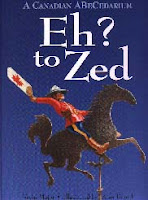 First up, Eh? to Zed: A Canadian ABeCedarium. Written by Kevin Major and illustrated by Alan Daniel, this is largely an illustrated book with pictures to pore over. Each page (and thus each letter) is allotted a page where Daniels has constructed a collage of images related to the letter. So, for example, the text for L is: Loon, lacrosse, Lillooet, lumberjack. And the accompanying image illustrates just that (with a twist in that the loon is a rubbing of the dollar coin, the "loonie.") But, like most picture books, there's more to it. If you read the text on both pages of a spread, you'll see you have rhyming stanzas such as this:
Gould, Gretzky, Greene, Grizzly bear
Habitant, Horseshore, humpback, hare
Daniel's illustrates the text in an interesting and varied way. For instance, for G we see Glenn Gould on the jewel case of a CD, a skating Wayne Gretzky, and a museum mounted grizzly bear (on a platform). Nancy Greene is shown on one half of one of those flip books where you can change the head, torso and legs of creatures (in this case people) to make funny images. We see Nancy's toqued-head and her legs with skis, but for a torso she has the back of Gretzky's (#99) jersey. Hmm, a little odd, but okay. The strange thing though is that a native person on the other side of the flip book (with a befeathered headress and leather-clothed legs and feet) has what appears to be a cowboy's torso. There is no mention of this native person here or in the text at the back of the book. An oversight or deliberately done to promote discussion? I'd love to know. (Actually, now I DO know! See below.)
At the back of the book there is a densely packed (VERY small font!) four-page spread of text and this is not to be missed: it is full of gems. The pages are titled The Choice of Words, The Choice of Images and is followed by: "Kevin Major's caravan of words cheers our history and celebrates our heroes. It couple the well known with the obscure, the curious with the symbols of our nation. For every province and territory there is a place name, for many junctions of our country something to be discovered. Here are some morsels of information the author came up with for the 104 words."
Even more enlightening and interesting are the notes to Daniel's art: "Alan Daniel's response to these 26 quartets of words reflects the cultural artefacts that have emerged throughout our history. The tableaus he has created are filled with both folk and fine art, the sacred as well as the commercial. They are objects to display in museums and toys to fill a child's idle hours. Several of them call for special mention." So, for example, the Mountie is a whirligig, the Humpback is a soapstone carving, and a cornhusk doll holds a Lacrosse stick. Here's what he has to say about the flip book for G: "A flip book can put Nancy GREENE on skates or make her namesakes Graham and Lorne do a switch-about in television land." Oh, you mean that's Graham Greene? Yikes, I never would have known unless I mined the back for this detail. It's unlikely Graham Greene or Lorne Greene will mean much to kids, but hopefully it won't be lost on the adult reader and it certainly made me want to pore over every other page to see what else would come to light.
Here's the Q, X and Z test:
Quahog, quarter horse, quints, Qu'Appelle
Xenon, xylograph, x-country, x-ing
Zamboni, zipper, zinc, zed
Okay, a bit of a stretch for some because xenon, Zamboni's, and zippers aren't really Canadian (zippers are marginally), but Major skillfully makes them fit in his explanatory notes, so I'll give him that!
In honour of Canada Day, or any day for that matter, this book is one for the bookshelves of all Canadian kids. Just don't forget to spend time with the four pages of notes at the end. They bring so much more to the book and truly make it interactive, not to mention giving an excellent grounding in the diversity of our countries history, geography, citizens, culture, and art.
Here's a review from Canadian Materials.
 First up, Eh? to Zed: A Canadian ABeCedarium. Written by Kevin Major and illustrated by Alan Daniel, this is largely an illustrated book with pictures to pore over. Each page (and thus each letter) is allotted a page where Daniels has constructed a collage of images related to the letter. So, for example, the text for L is: Loon, lacrosse, Lillooet, lumberjack. And the accompanying image illustrates just that (with a twist in that the loon is a rubbing of the dollar coin, the "loonie.") But, like most picture books, there's more to it. If you read the text on both pages of a spread, you'll see you have rhyming stanzas such as this:
Gould, Gretzky, Greene, Grizzly bear
Habitant, Horseshore, humpback, hare
Daniel's illustrates the text in an interesting and varied way. For instance, for G we see Glenn Gould on the jewel case of a CD, a skating Wayne Gretzky, and a museum mounted grizzly bear (on a platform). Nancy Greene is shown on one half of one of those flip books where you can change the head, torso and legs of creatures (in this case people) to make funny images. We see Nancy's toqued-head and her legs with skis, but for a torso she has the back of Gretzky's (#99) jersey. Hmm, a little odd, but okay. The strange thing though is that a native person on the other side of the flip book (with a befeathered headress and leather-clothed legs and feet) has what appears to be a cowboy's torso. There is no mention of this native person here or in the text at the back of the book. An oversight or deliberately done to promote discussion? I'd love to know. (Actually, now I DO know! See below.)
At the back of the book there is a densely packed (VERY small font!) four-page spread of text and this is not to be missed: it is full of gems. The pages are titled The Choice of Words, The Choice of Images and is followed by: "Kevin Major's caravan of words cheers our history and celebrates our heroes. It couple the well known with the obscure, the curious with the symbols of our nation. For every province and territory there is a place name, for many junctions of our country something to be discovered. Here are some morsels of information the author came up with for the 104 words."
Even more enlightening and interesting are the notes to Daniel's art: "Alan Daniel's response to these 26 quartets of words reflects the cultural artefacts that have emerged throughout our history. The tableaus he has created are filled with both folk and fine art, the sacred as well as the commercial. They are objects to display in museums and toys to fill a child's idle hours. Several of them call for special mention." So, for example, the Mountie is a whirligig, the Humpback is a soapstone carving, and a cornhusk doll holds a Lacrosse stick. Here's what he has to say about the flip book for G: "A flip book can put Nancy GREENE on skates or make her namesakes Graham and Lorne do a switch-about in television land." Oh, you mean that's Graham Greene? Yikes, I never would have known unless I mined the back for this detail. It's unlikely Graham Greene or Lorne Greene will mean much to kids, but hopefully it won't be lost on the adult reader and it certainly made me want to pore over every other page to see what else would come to light.
Here's the Q, X and Z test:
Quahog, quarter horse, quints, Qu'Appelle
Xenon, xylograph, x-country, x-ing
Zamboni, zipper, zinc, zed
Okay, a bit of a stretch for some because xenon, Zamboni's, and zippers aren't really Canadian (zippers are marginally), but Major skillfully makes them fit in his explanatory notes, so I'll give him that!
In honour of Canada Day, or any day for that matter, this book is one for the bookshelves of all Canadian kids. Just don't forget to spend time with the four pages of notes at the end. They bring so much more to the book and truly make it interactive, not to mention giving an excellent grounding in the diversity of our countries history, geography, citizens, culture, and art.
Here's a review from Canadian Materials.
Tuesday, June 24, 2008
One More Alphabet Book

Okay, a week or so ago I said I was going to review some alphabet books and then stopped at two. Not much of a list, so here’s another one: M is for Maple: A Canadian Alphabet. Another one from Sleeping Bear Press in Chelsea, Michigan. Apparently they have plans for one from each province (and territory perhaps?). If, like me, you’re wondering why an American publisher is so keen on Canadian content here’s some insight from the June 2008 issue of Quill and Quire: “…publisher Heather Hughes grew up in PEI and also lived in Edmonton before settling in Ann Arbor, Michigan.”
First, the Q, X and Z test:
Q is for Quebec
X marks the spot (where the Last Spike was driven)
Z is for zipper
I like how the author has handled the Z, which was actually not designed by a Canadian:
Z stands for Zipper, which everyone knows
is very important in tents and in clothes
A U.S. inventor had a zipperish notion
but it took a Canadian to get the zipper in motion.
In the notes that accompany this page, he adds more information. (The zipper was invented by an American, but it was perfected and patented by Canadian Gideon Sundback.)
The Canadiana covered in this title is broad indeed: Anne of Green Gables, Kim Campbell, the Dionne quints, Eh, northern lights, Ojibwa, Stampede, Underground Railway, etc. It’s a cursory look at the country, of course, but what can one do with only 52 entries. (Each entry has a main entry – the rhyming text – and then another entry for that letter. For example, U covers both Underground Railway and Ukranians.)
This title is written by Mike Ulmer and beautifully illustrated by Melanie Rose. Ulmer, who is the sport’s columnist at the Toronto Star, has also written a few other alphabet books, including J is for Jumpshot: A Basketball Alphabet and H is for Horse: An Equestrian Alphabet. Rose has been the illustrator for a number of Sleeping Bear titles and it's clear why -- her illustrations support the text well and, in particular, she captures the essence of people well. A particular favourite is the joy on the gold seeker's (K is for Klondike) face as well as the two children playing in a pile of ruby red maple leaves (M is for maple.) This last image is used on the cover.
Here’s a review from Canadian Materials and here's a teacher's guide.
Wednesday, June 04, 2008
More ABCs

Today, C is for Chinook: An Alberta Alphabet, another installment in Sleeping Bear Press's series of ABC books. (I've got one of my own ABCs cooking -- sad to hear they aren't taking submissions at the moment.) C is for Chinook is written by Dawn Welykochy and illustrated by Lorna Bennett. As in the S is for Spirit Bear, the BC title, the author gives a great overview of the people (Anthony Henday; The Famous Five, Nellie McClung and friends; John Ware, Mary Percy Jackson, etc.), places (Red Deer Valley, Lake Louise, Writing on Stone, Bar U Ranch, etc.), animals (Bighorn sheep, Great horned owl, etc.), and other phenomena representative of the province (e.g., Chinook winds, hoodoos, dinosaurs, icefields, etc.). The four-line poems pique the reader's interest (and may be enough for some), while the longer text blocks expand upon the topic of the page or add more.
Politics aside, I adore Alberta. I lived there for a few years, met my husband there, and travelled through the province as much as I could. I don't think there is a province in our vast country with such a breadth of fabulous parks and interpretive centres. Our most memorable family vacation was to visit friends in the Rockies then head over to southern Alberta to stay at Dinosaur Provincial Park, visit the Tyrrell Museum, walk through a coulee filled with dinosaur nests at a place whose name escapes me, marvel at the walls of petroglyphs at Writing on Stone Provincial Park overlooking the Milk River, then over to Fort MacLeod, Head-Smashed-In-Buffalo Jump and up to Frank Slide. Fabulous stuff. So, this was a nostalgic look back at the province I love.
Welykochy has done a masterful job of exploring the breadth of Alberta and this book provides 26 (and more!) places to springboard off on discussions of the natural and cultural history of the province. Lorna Bennett's uncluttered art, beautifully rendered, helps to evoke the many moods of the province. My favourite is the hunkered down "Doc" Mary Percy Jackson, riding horseback through a snowstorm enroute to assist the women who needed her.
Q test: Q's for erratic quartzite [at Okotoks] (a clever way to bring Okotoks and Ice Age in!)
X test: X stands for railway crossing/By train immigrants came to our land/Settling out west to farm,/ it was what the government planned. (X is a tough one; I'll give her that!)
Z test: Z is for a safari at the Zoo [illustration of zebras] (Segue into a discussion of the world-renowned Calgary Zoo.)
Here's a review from Canadian Materials. And here's a teacher's guide. Finally, meet the author, hear (and see) her read, and learn about the book at this YouTube video.
Monday, June 02, 2008
ABCs of Canada
I'm always on the prowl for alphabet books and have been fiddling with one myself, which will probably never see the light of day (or a printing press). Sleeping Bear Press, from Chelsea, MI, seems to specialize in them, including titles for Canada. Each has its own flavour and a different writer-illustrator team. All are worth a look. Let's start close to home...
 S is for Spirit Bear: A British Columbia Alphabet by G. Gregory Roberts and illustrated by Bob Doucet.
Each spread includes four lines of rhyming text and then a longer explanation of the ideas introduced in the stanza. Here's the entry for E:
E is for Emily Carr
with her artist soul and artist hand.
She inspired us with her written word,
and her paintings of her land.
As a lifelong resident of BC, I appreciate the breadth of the representations of BC the author included. Aboriginal people, dogwood (our provincial flower), Steller's Jay (our provincial bird), BC ferries, Steve Nash, Ogopogo, Zeballos, etc. Clearly, Roberts did his homework. He is cognizant, for instance, that after using Queen Charlotte Islands for Q, to mention the name preferred by the Haida residents, Haida Gwaii, and it's great to have so many current references, such as the discovery of "Kwaday Dan Sinchi, the "long ago person found." I have only a few quibbles, one being that I found a few of the rhymes a bit clunky and also that there was really not much representation of the northern part of the province (north of Haida Gwaii). Minor quibbles though and this book would make a great keepsake, introduction to the province, and useful resource in the classroom and library.
Any writing instructor will tell you that if you're interested in writing an ABC book, to do the Q, X and Z test first. If you don't have a good match for those letters, it's not going to fly. So, here's how Roberts approached the challenge:
Q test: "Q is for Queen Charlotte Islands,..." (BC has a few choices for Q, so this was a good choice.)
X test: "The name Terry Fox holds the X..." (Hmmm, a bit of a stretch, but Terry needs to be in this book, so I forgive!)
Z test: "Z is for Zeballos,..." (Nice exposure for this little island town.)
Here's a review from Canadian Materials and here's a teacher's guide.
 S is for Spirit Bear: A British Columbia Alphabet by G. Gregory Roberts and illustrated by Bob Doucet.
 Each spread includes four lines of rhyming text and then a longer explanation of the ideas introduced in the stanza. Here's the entry for E:
E is for Emily Carr
with her artist soul and artist hand.
She inspired us with her written word,
and her paintings of her land.
As a lifelong resident of BC, I appreciate the breadth of the representations of BC the author included. Aboriginal people, dogwood (our provincial flower), Steller's Jay (our provincial bird), BC ferries, Steve Nash, Ogopogo, Zeballos, etc. Clearly, Roberts did his homework. He is cognizant, for instance, that after using Queen Charlotte Islands for Q, to mention the name preferred by the Haida residents, Haida Gwaii, and it's great to have so many current references, such as the discovery of "Kwaday Dan Sinchi, the "long ago person found." I have only a few quibbles, one being that I found a few of the rhymes a bit clunky and also that there was really not much representation of the northern part of the province (north of Haida Gwaii). Minor quibbles though and this book would make a great keepsake, introduction to the province, and useful resource in the classroom and library.
Any writing instructor will tell you that if you're interested in writing an ABC book, to do the Q, X and Z test first. If you don't have a good match for those letters, it's not going to fly. So, here's how Roberts approached the challenge:
Q test: "Q is for Queen Charlotte Islands,..." (BC has a few choices for Q, so this was a good choice.)
X test: "The name Terry Fox holds the X..." (Hmmm, a bit of a stretch, but Terry needs to be in this book, so I forgive!)
Z test: "Z is for Zeballos,..." (Nice exposure for this little island town.)
Here's a review from Canadian Materials and here's a teacher's guide.
Wednesday, May 14, 2008
The Museum Book

I like to think that I'm a pretty with-it gal, but I never made the connection that the origin of the word museum is the word muse. Duh. There, I've admitted it for all to see. This is just one of the little gems I learned in The Museum Book by Jan Mark, illustrated by Richard Holland. (Subtitle: A Guide to Strange and Wonderful Collections.) If you've ever been in my house, you'll know that I'm a bit of a pack-rat myself and rather fond of strange and wonderful collections. My own "collections" (a word which might be a tad rich for my ephemera) have no particular purpose other than being things that please me for one reason or another (and, of course, don't cost too much), so this book--explaining the origin and purpose of museums--is right up my alley.
Before you move on, thinking this is all rather dull, take a moment to see how Mark writes this gem. This is from Chapter 4: "By Aldrovandi's time, every collector wanted the most curious cabinet of curiosities, the most wonderful chamber of wonders, the biggest collection. A century later, things were really getting out of hand. The collections grew too large for boxes, too large for rooms. It was all very well for kings and rich men, as they had plenty of space, but not all collectors were kings and rich men.
Perhaps one day the collector's wife looked at her house, overflowing with fossils and dried toads and corals and plants and books and dragons' teeth, the stuffed crocodile and the nasty shriveled thing under the stairs that gave her the creeps, and said, "Either all that goes or I do!" The collector would think about this for a while and then find someone to take the collection off his hands."
I love how she speaks directly to the reader, as if they are truly in the know, on her side. It's a kind of nudge-nudge, wink-wink style that is very appealing and fun (to me at least!). I've never heard of Jan Mark before, but she was prolific in her day. (She died in 2006.) Here's a site maintained by her Flemish fans. I'll have to check out Thunder and Lightnings and Handles, which both won the Carnegie Medal.
 The art by Richard Holland is a wonderful mixed-media collage style--perfectly eclectic for a book about museums, the most eclectic of things. Here's a peek at the first spread.
 Here's what a reviewer at The Observer had to say:
There could not be a more marvellous memorial of Jan Mark, who died last year, than The Museum Book, illustrated with bright elegance by Richard Holland. This is an argument she must have wanted to make. There is nothing dustily didactic about it. It is a passionate, unpatronising, offbeat paean to museums and multiplicity.
Saturday, April 26, 2008
Two of My Favourite Things
Now this is very cool. And it's not really that much of a stretch -- scientists, after all, are some of the most creative thinkers going. And if they can explain their work creatively and without the bafflegab and jargon, well, we're all the better for it.
While we're on the topic of science and literacy, the Canadian Science Writers' Association has announced the winners of their annual Science in Society book awards.

Winner in the 2007 children's book category: Baby Sea Turtle by Aubrey Lang and Wayne Lynch (Fitzhenry and Whiteside)

Winner in the 2007 youth book category: Polaris by Julie Czerneda (Fitzhenry and Whiteside)
While we're on the topic of science and literacy, the Canadian Science Writers' Association has announced the winners of their annual Science in Society book awards.

Winner in the 2007 children's book category: Baby Sea Turtle by Aubrey Lang and Wayne Lynch (Fitzhenry and Whiteside)

Winner in the 2007 youth book category: Polaris by Julie Czerneda (Fitzhenry and Whiteside)
Tuesday, April 22, 2008

Earth Day, a good time to redeem myself after yesterday's on-line hissy fit. Thank goodness there are far more fabulous books out there than aforementioned self-published dreck (I know, I know, there is some very well done self-published non-dreck) and Peter Sis's books are great examples of innovative non-fiction for kids.
In honour of the fact many of Charles Darwin's works are now on-line, I thought I'd take another peek at Sis's The Tree of Life (which has a subtitle reminiscent of the fabulously long titles of Darwin's time: A Book Depicting the life of Charles Darwin: Naturalist, Geologist & Thinker.) (Thanks to BookNinja, by the way, for alerting me to the Darwin archive and this article re. the release.) Using wonderfully detailed illustrations -- a Sis version of Where's Waldo and I Spy books, but much more beautifully rendered of course -- he introduces young readers to Darwin's life, his work, and some of his discoveries and ideas.
Here's Sis's Author's Note from the beginning of the book:
Charles Darwin regretted that he hadn't learned to draw. Instead, he kept detailed descriptions of everything he saw. It is these dense and vivid written passages in his diaries, letters and journals that have inspired me to use my own drawings, based on contemporary sources, to tell this story of his life. The text in my visualization of Darwin's diary entries has been freely condensed from his various writings about the voyage of the Beagle. Other sources for quotations and information include Darwin's autobiography, his letters, and the first edition of On the Origin of Species.
Sis takes us through Darwin's life story with the use of sketches, captioned illustrations, lists, diary entries, etc. We see Darwin as a child right through to his death. One of the most interesting spreads explained Darwin's serendipitous assignment as naturalist on the Beagle. We learn of his father's displeasure and how (with help from his maternal uncle Josiah Wedgewood), his father finally relented. On this spread Sis has used list to explain Father's Objections (e.g., That it would be a useless undertaking.) and then Practical Arrangements (e.g., case of strong good pistols; book on taxidermy; bible). Then we launch into his journey for several spreads followed by his life back in England, trying to piece it all together. (After the voyage, Sis clevery describes Darwin's activities into three parts: Public, Private, and Secret ("his developing a theory about the evolution and adaptation of species.)
Although I found the detailed drawings and explanations of his journey captivating -- and I'm sure younger readers will as well -- I'm not convinced that children will make the necessary leaps as to how he used these observations in his development of the ideas of natural selection. As I've written before, I think explaining natural selection and evolution is tricky and, in that vein, it can be such a challenge to distill it down. (Will young readers understand words such as adaptation and selection for instance?) So, while learning about Darwin's observations and discoveries on the Voyage of the Beagle are interesting in their own right, I'm not sure kids will make the connections between some of the things he'd seen on the voyage and his eventual development of the theory of evolution by natural selection. Of course Darwin took years to do this and he also incorporated other observations into this mix and I'm glad Sis included his (many) years after the Voyage as well. (As a side note, I was happy to see that Sis mention how Darwin spent eight years studying barnacles after his return. I always thought that was kind of quirky!)
Having said all this, I found this partial review by Roger Sutton at The Horn Book in the article The Ones That Got Away: Great Books That Didn't Get Their Due by Rick Margolis, in which Sutton makes a good point:
"Published to great reviews but no awards, Peter Sís’s The Tree of Life (Farrar/Frances Foster Bks., 2003) confounded those who wanted a straightforward explanation of evolution. Instead, the book is a remarkable joining of two imaginations, Sís’s and Darwin’s, hard at work to show us that scientific investigation is anything but straightforward. It instead requires the intense scrutiny of apparently disparate phenomena—just like this book.—Roger Sutton, The Horn Book"
(Yes, I agree, but I think this further points to how this book is definitely not a picture book for really young readers -- I think it's best suited for kids in the upper grades of elementary school and even beyond.) Quibbles aside, I think the book is a wonderful introduction to the life of one of our world's most important scientists and thinkers. His ideas (and of course those of Alfred Russel Wallace, who eventually came up with the same ideas, but was never as widely recognized) were indeed revolutionary and as the years go on are strengthened. The Teacher's Guide for this title is an added bonus, and will help strengthen many of the ideas introduced in the book. (Another reason why we need engaged and interested teachers and librarians in schools -- this book can bring you to a whole other level with wonderful instruction and discussion.)
Tuesday, April 15, 2008
Creatures Big and Small, Old and New

I am such a fan of Karen Patkau's work and I've had two of her books on my desk for awhile now, just waiting for a moment to blog. Karen is an illustrator and author from Toronto and she's published several books, including the natural history gems I have here: Creatures Great and Small and Creatures Yesterday and Today.
It's often the simplest of concepts that work so well. In Creatures Great and Small, Patkau explores animals of the world, but focusses on the large and small (although not always the largest and smallest) in each category. So, for the spread on amphibians she illustrates the Chinese Giant Salamander and the Poison Dart Frog. Four lines of text, written in the first person, give information on the animal pictured. For Chinese Giant Salamander, for instance, she writes:
I live in the mountains, among the rocks
of muddy riverbanks. Nocturnal, I am
awake at night. That is when I crawl along
the cold riverbed, searching for a meal.
Each text block reads almost like poetry to my ear. No doubt children will enjoy searching for the smallest creatures. On the spread on insects, for instance, the Feather-winged Beetle is about the half the size of a grain of rice. On the mollusk spread, a small garden snail "streaks" across the bottom of the page.
This book can be used in so many ways. Of course, children will love the bright illustrations and searching for the creatures, but parents and teachers can also use the book as a jumping off point for discussing animal classification (mammals, fish, birds, amphibians, arachnids, insects, etc.) and also units of measure. Two spreads at the end of the book help explain comparative sizes using kid-friendly terms (big, really big, small, really small), yet also have more complex ideas such as using grid squares to measure off size, and visual comparisons (e.g., actual size, 2 x actual size, etc.). This information may go over the heads of some children, but that's okay. At some point it will be useful even when they think they are too old for a picture book. (You never are, IMHO.) And I was so happy to see metric measures listed first, followed by imperial. Metric is, after all, the measure of science (not to mention Canada and most of the world; the US being the most notable hold-out).
Here's a review of Creatures Great and Small and the publisher's catalog copy.
 Creatures Yesterday and Today uses the same format but introduces us to creatures now extinct, and their distant relatives alive today. This is a fabulous concept and one that I don't think is tackled often, at least not in a picture book format. The first spread (labelled Creatures Yesterday), for instance, shows the dinosaur diplodocus. The text reads:
I was a giant planting-eating dinosaur,
with a big heart and a tiny brain. My neck
was so long, I could nibble fern leaves in
the forest while standing in an open field.
The next spread (Today) shows us a skylark with the text:
As I fly, you can hear my warbling song.
Like a theropod of long ago, I have a
wishbone, scaly feet, and hard-shelled
eggs. Am I a living dinosaur?
Theropod might send the teachers (but probably not the kids, who would know) searching for a dictionary, but Patkau has thought ahead and included a glossary for words that may need explanation. (And I'm wondering if planting-eating is an error -- plant-eating would certainly have scanned better.) Shelves are groaning with books on dinosaurs, but this book fills a gaping hole in paleobiology. Patkau goes beyond "dinosaurs as prehistoric animal" and introduces young readers to a broad range of prehistoric creatures: Hylonomus, Brontoscorpio, Smilodon, the crustacean Canadaspis and more, most of which they've probably never heard of. This is such a strength of the book. There is so much more to the prehistory of animals than dinosaurs and Patkau has sent young readers down the road to exploring the fascinating world of paleobiology.
Patkau's art at first glance seems simple, but it is so subtly rendered, with wonderful textures and patterns in each figure. The illustration of the Phorusrhacos, for instance, looks as if it has been carefully cut out of 10 or so different textured papers, yet it is computer generated. Patkau's style is definitely unique, engaging and recognizable. These books are as useful in art class and they are in science or language arts.
Both books include maps as endpapers, showing the relative locations of each animal illustrated. In Creatures Yesterday and Today, two spreads show a geological timeline and gives the approximate time when each of the prehistoric creatures lived.
Here's a review and the catalog copy for Creatures Yesterday and Today.
Saturday, March 29, 2008
INK, Camouflage, and other newsy bits of questionable worth
The sun is shining, the sky is blue -- could it be that spring has finally arrived here in Tough City? At least there's no snow, which would be unusual here anyway, but things were verging on bizarre because it snowed almost every day for about a week. Memories of Kaua'i are fading (as is my measly tan) as my To Do list grows. We probably should finally unpack sometime this weekend! Anyhow, I feel energized and vow to catch up on some posts and other things I've been meaning to do...
 Last night the hubbie and I actually had a date -- amazing. There was no protest from our youngest sprog, so we could depart guilt-free for a few hours. Took in a concert by Ian Tamblyn at the cozy venue, Trilogy Garden Cafe in the lovely Tofino Botanical Gardens. A smallish turnout, but it was a wonderful evening of music with friends. I have this sort of "six degrees of separation" with Ian Tamblyn as my friend Bill, whom I met at Lakehead U. in Thunder Bay way, way back when (could it really be 26 years ago?), roomed with Ian's brother. And, of course, we started listening to Ian's music back then, too. I'm a fan of his pieces, as in the albums Over My Head or Antarctica, where he's combined nature/animal sounds with his music. It was a treat to hear Ian in concert and to finally have a chance to say hello. He's got an impressively lengthy discography. We picked up two new ones; the latest - Superior: Spirit and Light and an older one from 1992, Through the Years.
 Since I'm primarily a non-fiction writer, it was a treat to hear of a new blog dedicated solely to children's non-fiction. INK - Interesting Non-fiction for Kids, is hosted by a variety of authors who take turns posting. Here's a great link on poetry in non-fiction by David M. Schwartz.
I was first introduced to David's work when we were doing the measurement issue of KNOW. David has written some wonderful books on measurement and math, such as G is for Googol or Millions to Measure. So I was delighted to come across his Where in the Wild? (written with Yael Schy, with photos by Dwight Kuhn) when I was on the Cybil's jury for non-fiction picture books.
He talks about Where in the Wild? in his INK post. Judging the Cybils was so difficult because, really, any of the books could have won. They were all fabulous and each had different strengths and styles and, of course, appealed to the jurists in different ways. Anyhow, Where in the Wild was a worthy finalist. The subtitle of this book is Camouflaged Creature Concealed...and Revealed. Even the creator line gives clues to the book's contents: "Ear-tickling poems" and "Eye-tricking Photos." Each spread has a poem (check out David's blog entry to see some of the pages) with an accompanying photo. In each photo an animal is hiding, well hidden by its camouflaged fur, feathers, scales, or skin. This was one of my favourite poems:
Speckled
speckled treasures lie
bare upon the pebbled bank
fragile life within
The photo is, indeed, of a pebbled bank and it hides the speckled eggs of a killdeer. When you lift the flap the eggs are revealed and there is a page of non-fiction information about killdeers. Such a nice combo. of photographs, poetry, non-fiction, with an added "Where's Waldo" quality. Other animals included in the title are the coyote, tree frog, deer, weasel, moth, crab spider, flounder, green snake and red-spotted newt. Other than a few small quibbles of complex ideas being glossed over (e.g., the evolution of peppered moths from light to dark) and some unexplained words (e.g., exoskeleton) it's a wonderful book sure to please. When I went to the Association for the Advancement of Science (AAAS) conference in Boston last month, Schwartz and Schy were awarded the 2008 AAAS/Subarus Excellence in Science Books awards. It was also noted as a 20087 Outstanding Science Trade Book by the National Science Teachers' Association.
You can listen to a review of the book on Just One More Book. They also have some great links, and can direct you to a teacher's guide and other goodies.
 Last night the hubbie and I actually had a date -- amazing. There was no protest from our youngest sprog, so we could depart guilt-free for a few hours. Took in a concert by Ian Tamblyn at the cozy venue, Trilogy Garden Cafe in the lovely Tofino Botanical Gardens. A smallish turnout, but it was a wonderful evening of music with friends. I have this sort of "six degrees of separation" with Ian Tamblyn as my friend Bill, whom I met at Lakehead U. in Thunder Bay way, way back when (could it really be 26 years ago?), roomed with Ian's brother. And, of course, we started listening to Ian's music back then, too. I'm a fan of his pieces, as in the albums Over My Head or Antarctica, where he's combined nature/animal sounds with his music. It was a treat to hear Ian in concert and to finally have a chance to say hello. He's got an impressively lengthy discography. We picked up two new ones; the latest - Superior: Spirit and Light and an older one from 1992, Through the Years.
  Since I'm primarily a non-fiction writer, it was a treat to hear of a new blog dedicated solely to children's non-fiction. INK - Interesting Non-fiction for Kids, is hosted by a variety of authors who take turns posting. Here's a great link on poetry in non-fiction by David M. Schwartz.
 I was first introduced to David's work when we were doing the measurement issue of KNOW. David has written some wonderful books on measurement and math, such as G is for Googol or Millions to Measure. So I was delighted to come across his Where in the Wild? (written with Yael Schy, with photos by Dwight Kuhn) when I was on the Cybil's jury for non-fiction picture books.
He talks about Where in the Wild? in his INK post. Judging the Cybils was so difficult because, really, any of the books could have won. They were all fabulous and each had different strengths and styles and, of course, appealed to the jurists in different ways. Anyhow, Where in the Wild was a worthy finalist. The subtitle of this book is Camouflaged Creature Concealed...and Revealed. Even the creator line gives clues to the book's contents: "Ear-tickling poems" and "Eye-tricking Photos." Each spread has a poem (check out David's blog entry to see some of the pages) with an accompanying photo. In each photo an animal is hiding, well hidden by its camouflaged fur, feathers, scales, or skin. This was one of my favourite poems:
Speckled
speckled treasures lie
bare upon the pebbled bank
fragile life within
The photo is, indeed, of a pebbled bank and it hides the speckled eggs of a killdeer. When you lift the flap the eggs are revealed and there is a page of non-fiction information about killdeers. Such a nice combo. of photographs, poetry, non-fiction, with an added "Where's Waldo" quality. Other animals included in the title are the coyote, tree frog, deer, weasel, moth, crab spider, flounder, green snake and red-spotted newt. Other than a few small quibbles of complex ideas being glossed over (e.g., the evolution of peppered moths from light to dark) and some unexplained words (e.g., exoskeleton) it's a wonderful book sure to please. When I went to the Association for the Advancement of Science (AAAS) conference in Boston last month, Schwartz and Schy were awarded the 2008 AAAS/Subarus Excellence in Science Books awards. It was also noted as a 20087 Outstanding Science Trade Book by the National Science Teachers' Association.
You can listen to a review of the book on Just One More Book. They also have some great links, and can direct you to a teacher's guide and other goodies.
Monday, October 15, 2007
Blog for the Environment

It's Blog Action Day and today's focus is the environment. So in that spirit, today's entry Tree of Life: The Incredible Biodiversity of Life on Earth by Rochelle Strauss (Kids Can Press, 2004). This large format book uses the tree as a metaphor -- the family tree of life on earth if you will. Strauss opens by speaking directly to the reader and comparing a family tree to the "Tree of Life" for all living things. From there, she introduces the five kingdoms of life: Monera, Fungi, Protoctista, Plants and Animals. Each of the first four kingdoms gets its own spread before we get a more detailed break-down of the Animal Kingdom, with its approximately 1 318 000 species. (Or, as Strauss relates the information, animals give 1 318 000 leaves to the tree of life.) Given that animals are ultimately more interesting to young readers than, say, cyanobacteria (although cyanobacteria are pretty cool, and we probably wouldn't be living on this planet without them), this was probably a good move. Each of the larger categories of animals gets its own spread (reptiles, fish, mammals, etc.).
The book is visually very beautiful, with lovely illustrations by Margot Thompson. The images of the organisms are bright and engaging and she's chosen some great species to illustrate, such as the Jamaican leaf-nosed bat, the tardigrade, and the panther chameleon. On each spread, Strauss gives a general introduction to the topic at hand and then gives us the numbers. (On the page for vertebrates, for instance, we learn there are 25 100 fish, 9800 birds, 8000 reptiles, 4960 amphibians, and 4640 mammals, totalling 52 500 leaves on the Tree of Life.) After this introductory sections, Strauss narrows in on a few organisms in detail. (For example, on page 15 we learn: "High up in tropical rainforests, the bromeliad grows into a "bowl" of leaves attached to a tree. This bowl catches water and becomes a habitat for many species of frogs, insects, spiders and worms. The largest bromeliad is just a bit smaller than a backpack. It can hold nearly 7.5L (2 US gal.) of water.")
The last page in the overview of the Tree of Life, finds us with 1 species: humans. This is an important page as children will learn that we are just 1 of the 1 750 000 leaves on the Tree of Life. As Strauss says: "Yet, with a population of over six billion, humans have the greatest impact on the Tree of Life." From there, readers learn about habitat loss and endangered species as well as some ways to help preserve habitats and our earth's biodiversity.
Children hear enough about global warming and recycling and turning off the lights to help "save the world." I'm not a fan of telling kids they can save the world, frankly. They've got enough to worry about without that weight on their shoulders, yet, I think it is very important they know where they fit in the scheme of things on our planet. And, hopefully, if they become more aware of the incredible diversity of life and habitats and cultures and religions and music and food and books ... well, just the diversity of life on our planet, they will learn to respect and care for all life. To that end, The Tree of Life is a wonderful tool -- it's not preachy, but it fuels the wonderful childhood quality: curiosity. Share the book with a child (or 30) and then get out there and discover the incredible diversity in your neighbourhood (even a yard or a ditch or a vacant woodlot can usually yield some treasures if one's willing to slow down and look).
The final spread in the book is an excellent Note to Parents, Teachers and Guardians, with more detailed information on the classification of living things as well as some more suggestions are exploring biodiversity with young people.
Saturday, October 13, 2007
ABC Spook Show

This is the Halloween book I'd really like to get my mitts on: ABC Spook Show. Who can resist an ABC book with entries "from Apparitions to Zombies." This title is created by the wonderful Vancouver artist, Ryan Heshka.
Here's a peek inside at the "M is for Mad Scientist" page, which I plucked from his web site.

And this is what The Georgia Strait magazine had to say about his book:
"Vancouver artist Ryan Heshka's love for old horror movies, 10-cent magazines, and stuff you send away for from the back pages of comic books is obvious in this Halloween-themed ABC book. Every page is beautiful, and the expressions of the ghosts, ghouls, and monsters are priceless. See the Mad Scientist pull the lever on the red alien squid ("Boys, this is it!")! Quake at the terrible hunger of the Imp ("Red-Itchy-Scaly")! Tremble at the electric-voodoo beams from the eyes of the Bat ("High-Voltage Fun")! If only the pages were twice as big…"
The Georgia Strait has reviews of a slew of other kids' books here. I'll be saving my pennies for this keeper.
Subscribe to:
Posts (Atom)